
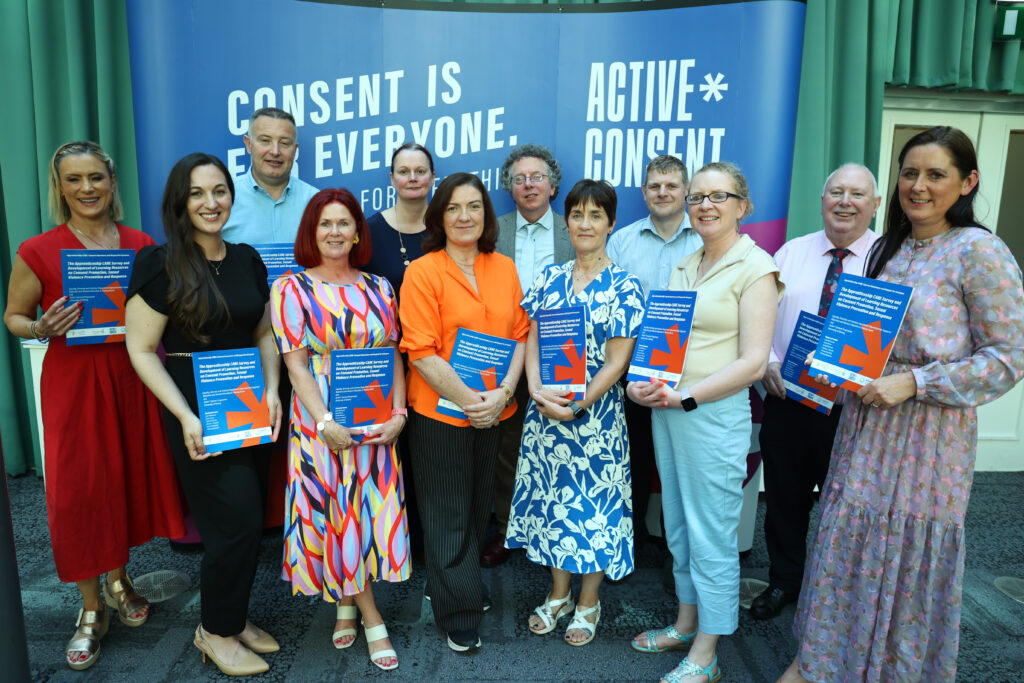
Waterford Wexford Education and Training Board (WWETB) Apprenticeship Supports service and the University of Galway Active* Consent programme have published the first report on the views held by craft apprentices on consent, sexual violence and harassment (SVH), bystander intervention, gender roles in intimate relationships, and knowledge of legal responsibilities and support services.
The Apprenticeship CARE Survey, led by WWETB Apprenticeship Supports and managed by Joann Power in collaboration with Sinead McGrath and the University of Galway, completed the research with 730 WWETB Phase 2 apprentices over a period of 13 months. Informed by survey responses the report recommends:
- Establishing consent education in apprenticeship programmes, with appropriate content to meet the needs of this group.
- Using this approach to implement consent education in apprenticeship programmes nationally.
- Collaboration within the Further Education and Training sector to pilot new resources and share learning.
This work builds on the Active* Consent programme’s outreach and education initiatives with the Further Education and Training sector nationally – which had reached over 3,000 staff members since 2022 and over 12,000 learners in this academic year alone. The report advocates for investment in consent, sexual violence and harassment prevention and response in the Further Education and Training (FET) sector, so that learners and staff achieve parity with similar achievements in Higher Education.
Joann Power, WWETB Apprenticeship Supports service said: “The WWETB Apprenticeship Support service is leading the way to enable Phase 2 apprentices, predominantly young men, to manage consent in their own lives, and to play their role preventing and responding to sexual violence. Our apprentices responded positively to taking part in the survey and helped us to design a consent education workshop. This success was based on presenting realistic scenarios that allow apprentices’ voices to be heard”.
Caitríona Cullen, Director of Further Education and Training, WWETB said: “WWETB was delighted to partner with the Active* Consent programme at University of Galway, shining a light on consent education for apprenticeship programmes. We look forward to seeing how this important piece of work helps inform future consent education resources, and we look forward to the continued partnership in its delivery”.
Sinead Mc Grath, Further Education and Training Lead, Active* Consent Programme said: “Taking a positive but educational approach to working with young men on consent behaviour starts with strengths. For example, nearly all apprentices in the survey agreed that you need to talk about consent before being intimate with someone. We share that in the workshop before opening up the discussion about issues like confidence in talking, the impact of alcohol and of the expectations we have learned growing up”.
Professor Pádraig MacNeela from the School of Psychology at University of Galway said: “Apprentices are a cross-section of young men in our society. Their views and behaviours reflect what their peers around the country are saying and doing. As we can see from the survey findings, only half of apprentices have spoken with friends about consent. So getting time and space to work with them in this setting is such an important step in creating more conversations about consent”.
The Apprenticeship CARE Survey: Selected findings
Survey demographics: 96% of the 723 survey participants were men, 92% were aged under 25 years. They were taking part in a craft apprenticeship.
Previous experiences of consent education
76% of apprentices were satisfied with the sex education that they had previously received in school or previous courses, but their experiences of consent were largely passive:
- 93% received a talk from a teacher.
- 80% watched a video in class.
- Less than half (46%) of apprentices had experienced interactive, discussion-based consent workshops to help them reflect on their views and hear from their peers.
Consent Awareness
- 88% agreed that verbal consent should apply to all forms of intimacy.
The apprentices also identified communication challenges in practice:
- 50% reported that verbally asking for consent was awkward.
- Only 51% had discussed consent with a friend.
Digital intimacy
There was clear recognition of the risk of image sharing:
- Over 80% recognised that sharing of intimate images is risky and creates vulnerability.
However, some attitudes were also ambivalent:
- Over 50% viewed intimate image sharing as exciting or positive.
- 48% agreed that it is a normal feature of relationships.
Bystander intervention
95% of apprentices felt somewhat or well prepared to act if they saw sexual violence or harassment taking place.
However, the likelihood of intervention dropped for everyday problematic behaviours:
- 36% would challenge sexist language.
Clarissa DiSantis, Education & Training Co-Lead with the Active* Consent programme said: “This work will bring the Active* Consent message to apprentices that consent is ongoing, mutual, and freely given, for all relationships, genders and orientations. Our education model enables people to reflect on and talk about consent in a safe and engaging way, and prepares staff members in their support role too”.
Turning the survey findings into practical education resources
The Apprenticeship CARE Survey findings are now being used to develop new education resources, such as education workshops and a poster series. The next phase of collaboration between WWETB and Active* Consent will co-create learner-centred approaches to consent education and prevention of sexual violence.
Workshop piloting confirms that apprentices value:
- Scenario-based learning
- Group debate activities
- Practical communication exercises
- Application of the Active* Consent “OMFG” (Ongoing, Mutual, Freely Given) model
All 48 apprentices who took part in the first round of piloting recommended the workshop to a friend (one apprentice said it was “Good fun and educational … really good for communicating consent”).